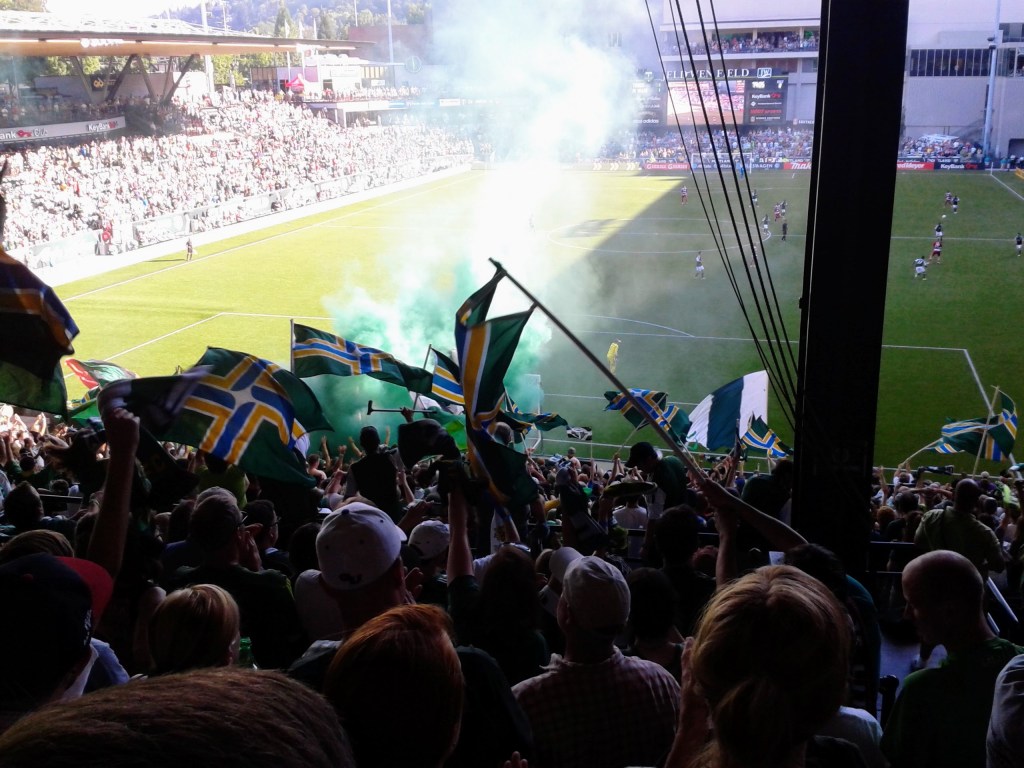
When fans chant and drums echo through Providence Park, it is easy to get swept up in the excitement of a Portland Timbers match. However, behind the scenes, every goal and gravity-defying save is a story of a public-private partnership that reshaped an aging stadium into a state-of-the-art venue, thanks partly to taxpayer dollars and city planning.
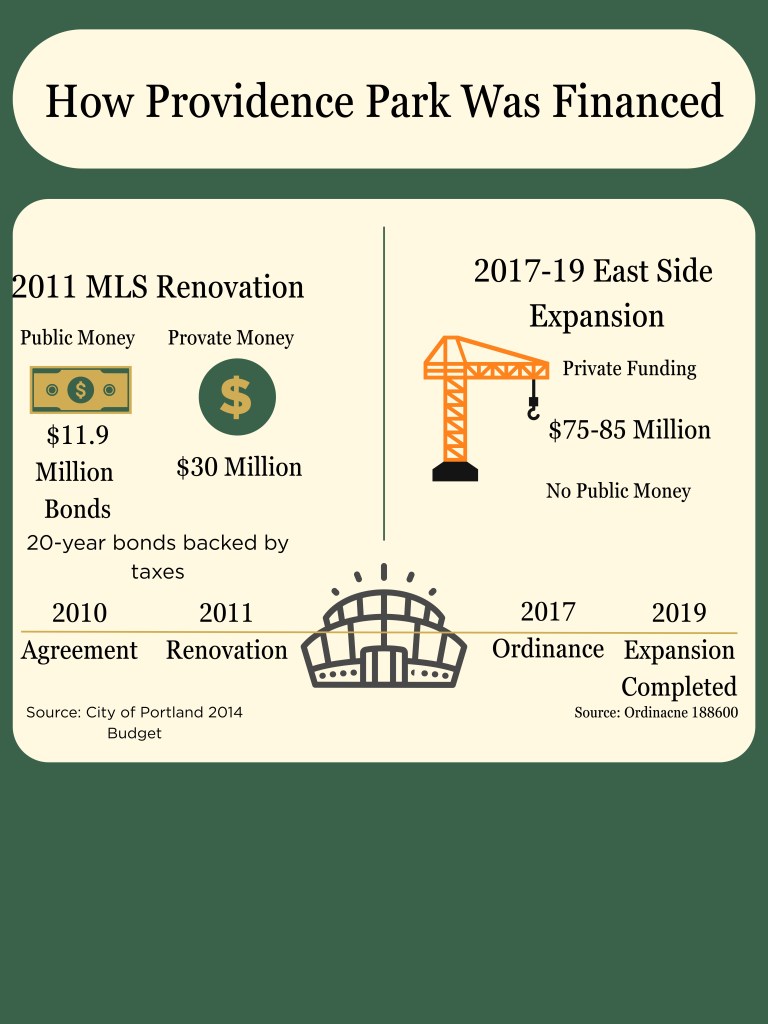
To secure an MLS expansion franchise, the City of Portland and Timbers owner Peregrine Sports LLC agreed in 2010 to overhaul the aging facility. Details of that bargain appear in the FY 2014-15 Adopted Budget, Volume 2. The Spectator Facilities Operating Fund section confirms that the City’s share was “about $12 million,” financed with 20-year bonds scheduled to be retired in FY 2026-27 (City of Portland, 2014). Those bonds are repaid with ticket surcharges, user fees, and portions of transient-lodging taxes rather than the General Fund, a structure designed to insulate everyday services from stadium costs. Private investment by Peregrine Sports exceeded $30 million, giving the club operational control while the city retained ownership of the facility. The budget document also notes a 25-year operating agreement that started in 2011.
Success on the field and repeated sell-outs created a ticket scarcity crisis, prompting the club to pursue a 4,000-seat expansion. City Council had to approve an above-grade encroachment because the proposed structure would cantilever over SW 18th Avenue. That approval came via Ordinance No. 188600 on September 13, 2017, which accepted the City Engineer’s Report for the Providence Park Stadium Expansion (City of Portland, 2017). The ordinance’s findings highlight:
- A new roof rising 100 feet above the sidewalk
- A commitment that no City money would fund the project
- A five-year sunset clause voiding the permit if construction did not proceed
- Coordination with the Portland Bureau of Transportation to keep light-rail infrastructure clear
These stipulations exemplify how zoning and right-of-way rules can shape, and sometimes constrain, privately financed sports construction on public land.
The 2014 budget table and the 2017 ordinance illustrate the two phases of Providence Park’s modern era. The first relied on tax-supported bonds to unlock MLS membership, while the second leveraged regulatory approval (not cash) to let private dollars add capacity. For the people of Portland, the lesson is clear: public investment in sports venues rarely ends with the first ribbon cutting. Continuous oversight is essential to balance civic pride with fiscal responsibility.
As the Timbers Army sings on match day, the stadium “belongs to us.” Thanks to transparent public records, taxpayers can see exactly how accurate that lyric is. Timbers’ ownership was invested in the city, and the city repaid Timbers’ ownership. Situations like this are not always the case when professional sports teams have stadium needs.
References
City of Portland. (2014). City funds & capital projects (Vol. 2): Spectator Facilities Operating
Fund—Providence Park. In FY 2014–15 Adopted Budget. Retrieved from
City of Portland. (2017). Ordinance No. 188600: Accept City Engineer’s Report for Providence Park Stadium Expansion Above-Grade Encroachment. Retrieved from https://efiles.portlandoregon.gov/record/11206397/file/document


Leave a Reply